Swimming Lesson
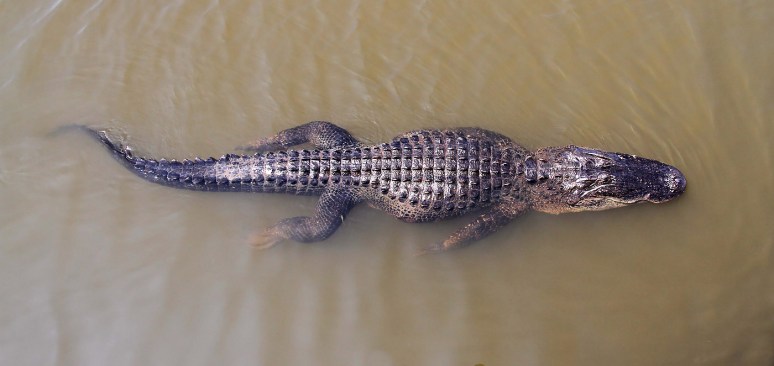
Here is an overhead view of an alligator in the water which will give you a good idea of how they swim. Their legs are not used for swimming and instead dangle loosely at their sides. They use their strong tails only for propulsion. Generally they take a leisurely cruise around the marsh pond but if a big guy starts to chase a little guy those tails can get them moving very fast through the water. Their acceleration is quite impressive!
Although it is tough to judge size from this photo, it was about a 7-8 footer. I used a 16-35 lens for this so it’s a real wide shot.
 Phil Lanoue Photography
Wow, what a great shot! The detail in its skin texture is amazing. How did you get directly above it?
LikeLike
Thanks glad you like it!
There is a wooden walkway that extends about 12-15 feet out and over one of the marsh ponds. When I saw this alligator come gliding in and I realized it would pass practically right under me I leaned over with the camera and grabbed this shot as it went by.
LikeLike
You do go where angels fear to tread!!! Remarkable! Every time I come by, you remind me what an amazing world we live in….
LikeLike
Well I’m very happy you stopped by and glad to know you enjoy the photos!
LikeLike
Always – can’t miss a post!!!!
LikeLike
Nice perspective. How did you get above him?
LikeLike
Thanks.
There is a wooden walkway that extends about 12-15 feet out and over one of the marsh ponds. When I saw this alligator come gliding in and I realized it would pass practically right under me I leaned over with the camera and grabbed this shot as it went by.
LikeLike
It looks like a newt! Are you basically saying they are just floating and using the tail to move them slowly along? Sounds a bit like me going up and down the swimming pool using arms or legs only.
LikeLike
Yes they basically do just glide or float along using only the tail to propel them. You would be shocked at how fast they can swim though using this method if the need arises.
LikeLike
Quite scary beasts…….
LikeLike
Nah, they are cute and cuddly. 🙂
LikeLike
Wow Phil, a close encounter of the 3th kind, Wonderful shot my friend. 🙂
LikeLike
Thanks very much Jan, so glad you enjoyed this alligator photo!
LikeLike
Awesome photo!
LikeLike
Thanks Hans, I appreciate it.
LikeLike
Oh, I didn’t know this informations. Thanks for telling!
LikeLike
I’m happy to know you found the info helpful, thanks for looking!
LikeLike
Yikes, not only a wide shot, but a close one as well judging from that lens! Very brave of you. Great image.
LikeLike
Yes a wide shot at 16mm but it was just right under me. Not a good time to drop the camera, can’t see myself jumping in to get it. 😯
Thanks for checking this out.
LikeLike
Nice view from above! We’re you on the gazebo?
LikeLike
Thanks Sue, I was out on the walkway looking down.
LikeLike
Of course you are wearing some kind of press pass so he understands you are not supposed to be bitten or chewed.
LikeLike
I always carry my Official Alligator Photographer credential! They see that and automatically know I’m fully authorized. 😀
LikeLike
Interesting to learn that. Thanks for sharing the information.
LikeLike
Thanks for looking and glad you liked reading the info!
LikeLike
I’m curious how you managed this, too?
LikeLike
There is a wooden walkway that extends about 12-15 feet out and over one of the marsh ponds. When I saw this alligator come gliding in and I realized it would pass practically right under me I leaned over with the camera and grabbed this shot as it went by.
LikeLike
That’s pretty amazing!
LikeLike
awesome, love this… a lot.
LikeLike
Thanks I appreciate your kind comments!
LikeLike
Love this perspective!
LikeLike
I’m happy you enjoyed seeing this shot!
LikeLike
A good candidate for a go pro cam. Alli-Cam?
LikeLike
I’ve had thoughts of getting an RC helicopter with bottom facing camera and sending it out over one of these guys.
I figure I would more then likely lose the copter in the marsh though and I’m not going in to fish it out. 🙂
LikeLike
I learn more about gators from you, than i ever learned in my school years …
I like your photos as well as your informative text // Maria
LikeLike
Well I am glad you are enjoying the photos and the information, thanks very much Maria!
LikeLike
What an amazing photo, Phil. Were you perched on a tree branch? 🙂
LikeLike
Thanks much Sylvia, glad you liked this alligator pic! No tree branch I was just on a walkway overlook in the pond. But I’m going to remember your tree suggestion for next time!
LikeLike
Oh goody, but please don’t hold me responsible if you fall in. 😀
LikeLike
If that ever happened, I guess no one would ever know it was your suggestion. 😯 So you are in the clear. 🙂
LikeLike
Phew!! 😀
LikeLike
You’re right, that wide angle fooled me. I thought it was a baby gator just floating along.
LikeLike
Yeah that’s why I figured it would be a good idea to mention the size and lens perspective. The wide angle lens was required to get all of this boy in the same frame. 🙂
LikeLike
An interesting shot Phil. I too was curious as to how you captured this shot but the comments cleared that up. I guess this would be quite a small gator?
LikeLike
Thanks for checking this out Adrian. At 6-8 feet (approx. 2.1 meters) long this would be a fairly typical size pond alligator we would likely see. Any smaller then 5 feet we consider ‘babies’ and the larger ones at 8-12 feet, when they come out, would be the head gator in charge and pretty much have the run of the entire pond and marsh area.
LikeLike
This alligator looks like he’d make a good floatie for me to be lazy in the water this summer. Fantastic shot!
LikeLike
Oh he would be perfect for that! He is just like a big squishy pool toy anyway. 🙂
LikeLike
The more I read your stories, the more I realise I have to learn about the creatures we share our world with! Thank you Phil!
LikeLike
Well I’m very happy you have been enjoying the photos and the little stories I provide with them!
Thanks Maggie!
LikeLike
Beautiful detail on his scales there, and I love the lazy way of swimming. Hi Mum, by the way; I’m posting underneath you again! 😀
LikeLike
Thanks much Lucy so glad you enjoyed the photo of our friend Mr. Gator!
Nice to see you and mum together! 😀
LikeLike
I learn a little more about your neighbours every day – cheers Phil
LikeLike
Great perspective, Phil – different from the usual. They certainly are remarkable creatures.
LikeLike
Pingback: The Truth Behind the 'Drowning': Bizarre Behavior of Crocodiles Underwater - Exploring Animals